- Why this route works?
- Before you book
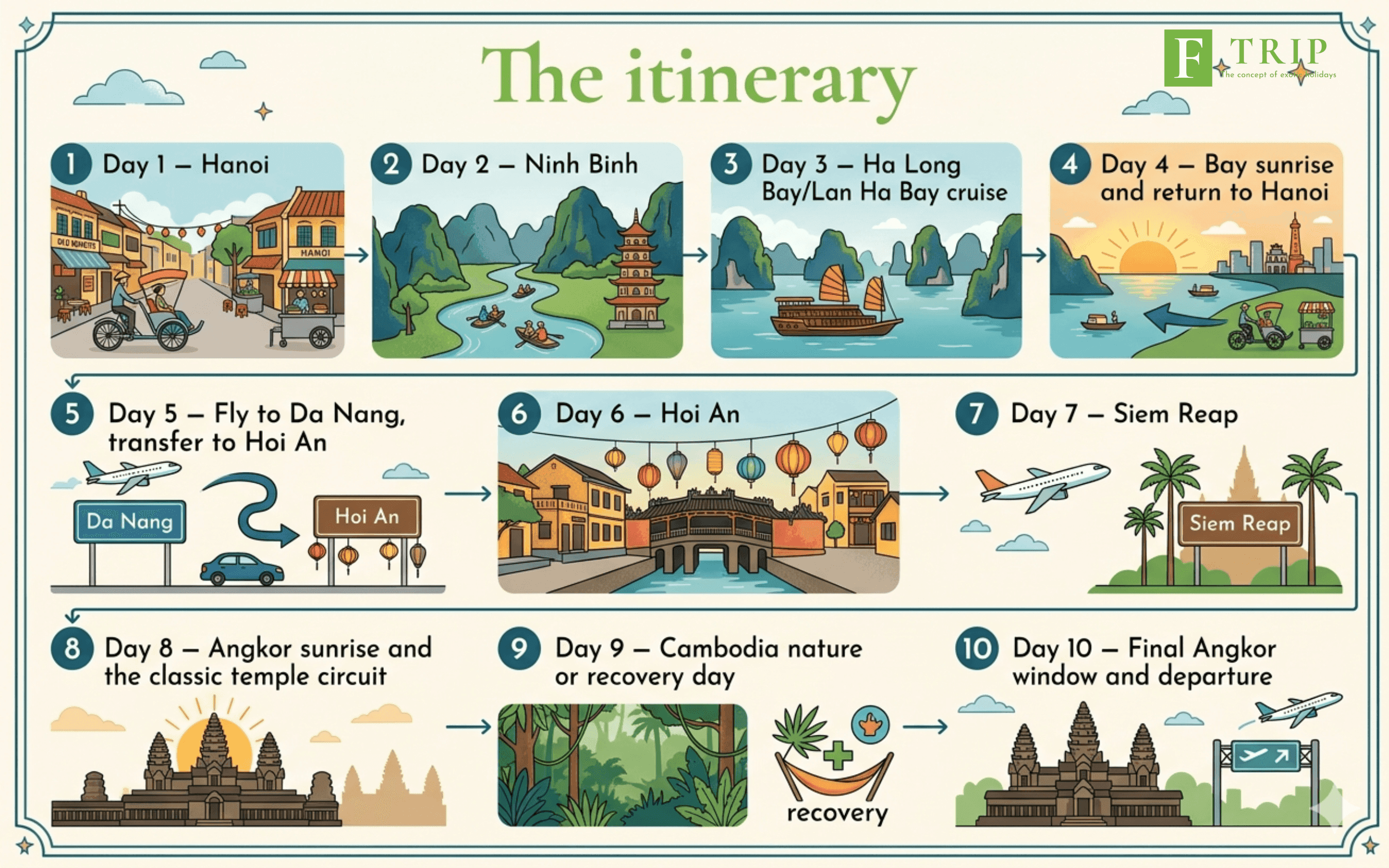
- The itinerary
- Day 1 — Arrive in Hanoi
- Day 2 — Ninh Binh day trip or overnight start
- Day 3 — Ha Long Bay or Lan Ha Bay cruise embarkation
- Day 4 — Bay sunrise and return to Hanoi
- Day 5 — Fly to Da Nang, transfer to Hoi An
- Day 6 — Hoi An scenic adventure day
- Day 7 — Fly to Siem Reap
- Day 8 — Angkor sunrise and the classic temple circuit
- Day 9 — Cambodia nature or recovery day
- Day 10 — Final Angkor window and departure
- Where to stay?
- What to book early?
- Packing for this route
- Is 10 days enough?
- Conclusion
If this is your first time combining Vietnam and Cambodia in just 10 days, the smartest move is to chase landscapes, not checklists. A route built around Ninh Binh’s karst valleys, Ha Long or Lan Ha Bay’s limestone seascapes, Hoi An’s coast-and-countryside mix, and Angkor’s sunrise finale gives you a lot of visual payoff without wasting too many days in transit. This order also works well logistically: northern Vietnam first, central Vietnam second, then Cambodia last.
For visas, use only the official government portals. Vietnam’s official e-visa system states e-visas can be valid for up to 90 days and may be issued for single or multiple entry, depending on eligibility and entry rules. Cambodia’s official e-visa site is evisa.gov.kh, and Angkor tickets can be bought from the official government-run Angkor Enterprise site.
Why this route works?
This itinerary fits first-time travelers who want strong scenery with moderate movement. It avoids the biggest mistake in short multi-country trips: trying to sample too many Vietnam regions at once. Ninh Binh and Ha Long are close enough to Hanoi to combine efficiently, Hoi An is easy to reach via Da Nang airport, and Siem Reap is the cleanest Cambodia finish because Angkor is the country’s highest-impact first-timer experience.
Before you book
Plan around a few non-negotiables. Book your bay cruise early, because cruise quality shapes the experience more than almost anything else. Book the two key flights early as well: Hanoi to Da Nang and Vietnam to Siem Reap. Also, save PDF copies of your visas and confirm your exact Vietnam entry and exit points match the ports allowed for e-visa use.
For weather and scenery, this route is easiest in Vietnam when Ha Long and Hoi An are outside their wettest stretches. Vietnam’s official tourism guide says Ha Long is especially pleasant from September to November, while Hoi An is generally strongest from March to May, with heat building from June to August and wetter months from October to January. Ninh Binh is commonly framed as best enjoyed slowly, with early starts helping you beat both heat and crowds.
The itinerary
Day 1 — Arrive in Hanoi
Keep Day 1 light. Stay near the Old Quarter or just outside it so you can walk easily without spending the first night in the noisiest lanes. A Hoan Kiem area walk and a rooftop or lakefront sunset is enough. You want energy for the nature-heavy days that follow. Hanoi also works well as a short recovery base because Ninh Binh and Ha Long are both close enough for efficient departures.
Day 2 — Ninh Binh day trip or overnight start
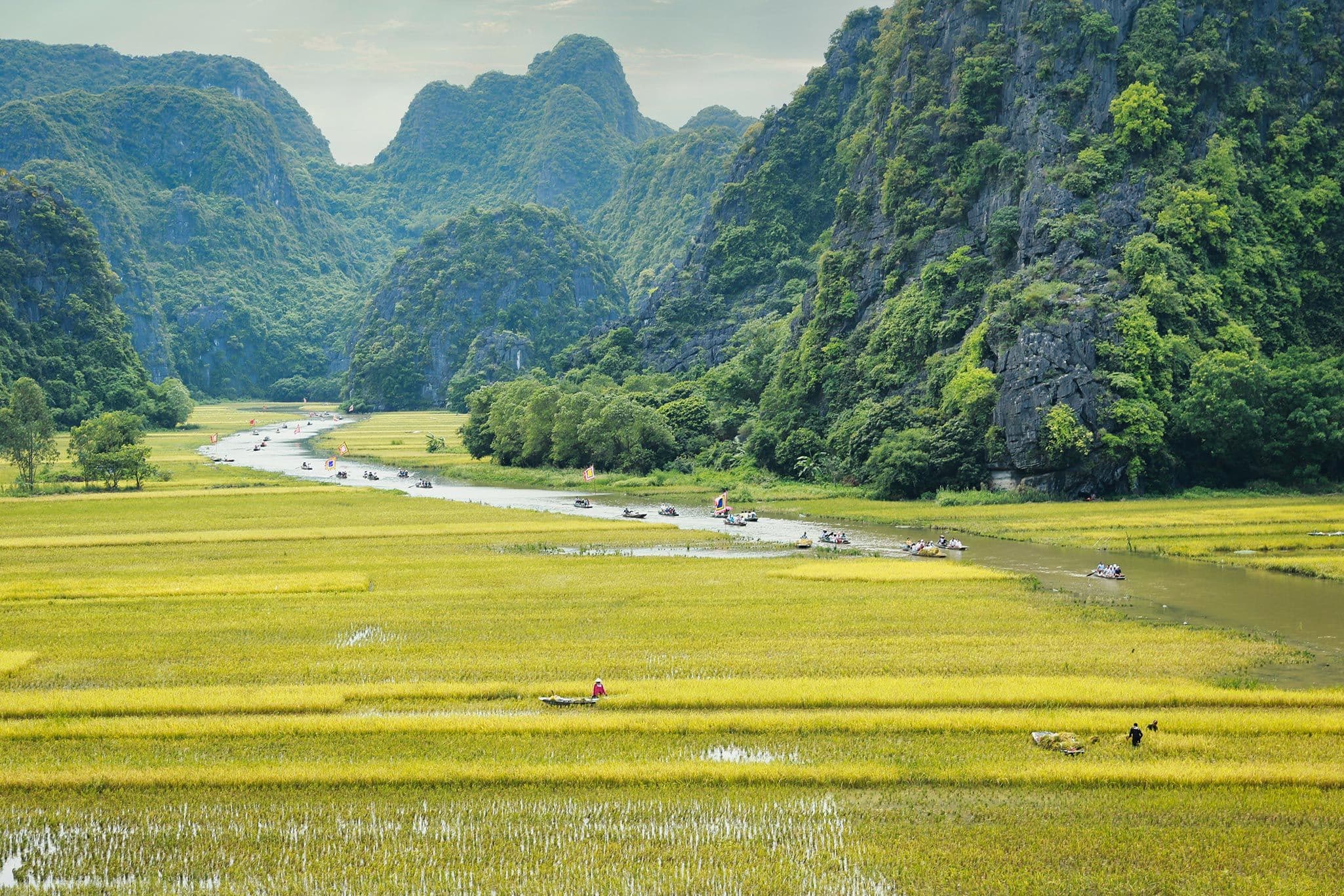
Leave Hanoi early for Ninh Binh. Official Vietnam tourism pages describe Ninh Binh as about two to two-and-a-half hours from Hanoi, depending on route and transport. For a first-timer scenic day, choose one main boat ride, not two. Trang An is the better all-round choice if you want the strongest UNESCO-core karst-and-cave experience, while Tam Coc is better if your priority is rice-field river scenery. Add Hang Mua for the panoramic finish if your energy allows.
A tighter version is to return to Hanoi that night. A better scenic version is to sleep in Ninh Binh and enjoy the countryside more slowly, because official tourism guidance explicitly suggests the area is best experienced beyond a rushed day trip.
Day 3 — Ha Long Bay or Lan Ha Bay cruise embarkation
Transfer from Hanoi to the Bay Area in the morning. Vietnam’s official tourism site describes Ha Long as about two hours outside Hanoi, while many packaged transfers and limousines effectively land in the broader 2–3 hour range, depending on pickup style and port. For scenic-adventure travelers, prioritize a 2D1N cruise that includes kayaking, because Vietnam’s official Ha Long guide explicitly highlights kayaking through lagoons and around karsts as one of the best experiences in the bay.
If you prefer the calmer feel of Lan Ha Bay, that is a good swap. Vietnam’s official bay guide notes that Ha Long, Lan Ha, and Bai Tu Long all offer similar limestone seascapes, but the route style varies by operator. The key booking question is not only “Ha Long or Lan Ha,” but whether kayaking is included and whether the route gives you quiet water time rather than only sightseeing from the deck.
Day 4 — Bay sunrise and return to Hanoi
The value of an overnight cruise is the rhythm: sunset on the bay, sleeping among the karsts, then waking up to a quiet morning. Vietnam’s official Ha Long guide specifically calls out sunrise deck views and kayaking as signature experiences. After the morning activity and brunch, return to Hanoi. Keep the evening easy.
Day 5 — Fly to Da Nang, transfer to Hoi An
Fly south to Da Nang, then continue to Hoi An. Vietnam’s official tourism guide says Da Nang airport is about a 50-minute drive from Hoi An Ancient Town. That makes Hoi An an efficient base for a short scenic stop: old town at night, countryside in the morning, coast if you want it.
Spend the evening in Hoi An Ancient Town, but do not overpack the night. Lantern streets and a riverside walk are enough for Day 5. Hoi An’s official tourism guide also emphasizes that the destination’s charm comes not only from the old town, but from its setting among rice paddies, rivers, and beaches.

Day 6 — Hoi An scenic adventure day
Build Day 6 around one scenic theme, not three. The easiest low-stress option is countryside cycling through places like Tra Que or Cam Thanh, because Vietnam’s official tourism content highlights sunrise and morning cycling among green fields as one of Hoi An’s signature experiences. A beach sunset at An Bang works well if you want a slower finish.
If you want a more dramatic drive day, a Hai Van Pass outing is a strong option. Vietnam’s official route article describes the Hoi An to Hue coastal road over Hai Van Pass as one of Southeast Asia’s most spectacular journeys. That is more movement than a pure Hoi An day, though, so only choose it if you actually want the drive itself to be the adventure.
Day 7 — Fly to Siem Reap
Fly to Siem Reap and keep the day intentionally light. Sort your Angkor pass, transport plan, and sunrise timing for the next morning. Buy tickets through Angkor Enterprise, the official government-run ticket site.
Day 8 — Angkor sunrise and the classic temple circuit
This is your peak Cambodia day. UNESCO describes Angkor as one of Southeast Asia’s most important archaeological sites, extending over roughly 400 square kilometres with temples, hydraulic structures, roads, and reservoirs. That scale is why Angkor rewards a focused first-timer circuit rather than trying to “see everything.” The most efficient first-day route is sunrise at Angkor Wat, then a best-hits flow through Bayon and Ta Prohm, followed by a midday rest and a lighter late-afternoon session.
A practical note: official and quasi-official Angkor visitor guidance shows sunrise access and early entry are built into the visitor pattern, which is why sunrise remains the standard first-timer move.
Day 9 — Cambodia nature or recovery day
Use Day 9 as a contrast day. Tonlé Sap is one of the easiest nature-and-culture add-ons from Siem Reap, and Cambodia tourism sources describe it as a biosphere reserve ecosystem with floating-village experiences. If you are already temple-tired, you can also make Day 9 a slower recovery day around Siem Reap instead of forcing another full excursion.
If you strongly prefer a land-based nature day, Phnom Kulen is a common alternative, but I did not find a strong official park source in this search to support detailed planning advice, so I would treat it as a secondary option and verify current logistics locally before committing.
Day 10 — Final Angkor window and departure
Use the final morning only for one short, high-value stop. That could mean a second sunrise attempt if Day 8 was cloudy, or a final favorite temple with less pressure. Then transfer to the airport. Angkor is large enough that leaving space for one last short visit usually feels better than trying to squeeze in a whole new circuit.

Where to stay?
Stay near the Old Quarter edge in Hanoi for walkability without maximum noise. In Hoi An, choose either the old-town edge for easy evenings or the beach side if sunsets matter more than lanterns. In Siem Reap, a central hotel is the easiest if you want simple nights after Angkor. For the bay, cabin quality matters more than city-hotel style because you are really buying sleep quality and deck time. These are itinerary-based recommendations supported by each destination’s official access patterns rather than a single hotel source.
What to book early?
The three items most likely to affect trip quality are the bay cruise, the two flights, and your visa paperwork. For Cambodia, buy Angkor tickets only from the official site. For Vietnam, use only the official e-visa system and confirm your port of entry.
Packing for this route
Pack for water, sun, and early starts: quick-dry clothes, shoes with grip, a waterproof pouch for boat days, sun protection, and a light layer for early bay and temple mornings. That advice follows directly from the activity mix in Ninh Binh, Ha Long, Hoi An countryside, and Angkor sunrise.
Is 10 days enough?
Yes, if you keep the route efficient. This itinerary works because it stacks three high-impact scenic experiences — Ninh Binh, the bay, and Angkor — and limits the number of major moves. The compromise is that you should not expect deep immersion at every stop. Ten days is enough for a strong first-time overview, not a slow grand tour. That is an itinerary judgment based on the transfer times and attraction blocks above.
Conclusion
This 10-day Vietnam and Cambodia itinerary works because it stays disciplined. It gives you karst valleys in Ninh Binh, limestone seascapes in Ha Long or Lan Ha Bay, coast-and-countryside in Hoi An, and a world-class Angkor finale, without turning the whole trip into airport and bus terminal time.
If you want the trip to feel adventurous rather than exhausting, keep your biggest experiences in the mornings, book the bay cruise and flights early, and leave just enough flexibility for weather and energy. That is what makes a short two-country trip feel smooth instead of overstuffed.