FTRIP HOLIDAYS TRAVEL GUIDES
Welcome to Vietnam
Major Cities: Ho Chi Minh City (Saigon), Da Nang, Hue, Hoi An, Sapa
Unique Highlights:
- World-renowned cuisine (pho, banh mi, fresh spring rolls)
- Breathtaking natural landscapes
- UNESCO World Heritage Sites, including Ha Long Bay, Hoi An Ancient Town, and Phong Nha-Ke Bang National Park
- Rich history spanning dynasties, colonial influences, and wartime legacies
- Vibrant markets, festivals, and a deep-rooted culture of hospitality
Visa to Vietnam
Vietnam Visa Information (Updated August 2023)
Visa Exemption
Travelers from 25 countries can enter Vietnam without a visa:
90 days: Chile, Panama 45 days: Belarus, Korea, Japan, Germany, Denmark, Norway, Russia, France, Finland, Spain, Sweden, Italy, United Kingdom 30 days: Cambodia, Indonesia, Kyrgyzstan, Laos, Malaysia, Singapore, Thailand 21 days: Philippines 14 days: Brunei, Myanmar
Please note: Your passport must be valid for at least 6 months from your entry date.
Visa on Arrival (VOA)
Available for selected nationalities entering Vietnam by air. How it works:
- Send us your passport details.
- We apply for your Visa Approval Letter with Immigration.
- Print the letter and bring it on your flight.
- Upon arrival, present your Approval Letter, passport, photos, and cash (USD) for the stamping fee at the VOA counter.
You may arrive later than your approved date, but not earlier. Visa fees are non-refundable.
E-Visa for All Countries
Since August 15, 2023, travelers from all nationalities can apply for a Vietnam e-Visa online.
- Valid for up to 90 days (single or multiple entry).
- Application fee: USD 25 (single) / USD 50 (multiple) — non-refundable.
- Requires:
- Passport valid ≥ 6 months
- Digital photo (white background)
Apply online here: https://evisa.xuatnhapcanh.gov.vn/web/guest/khai-thi-thuc-dien-tu/cap-thi-thuc-dien-tu
Best travel time
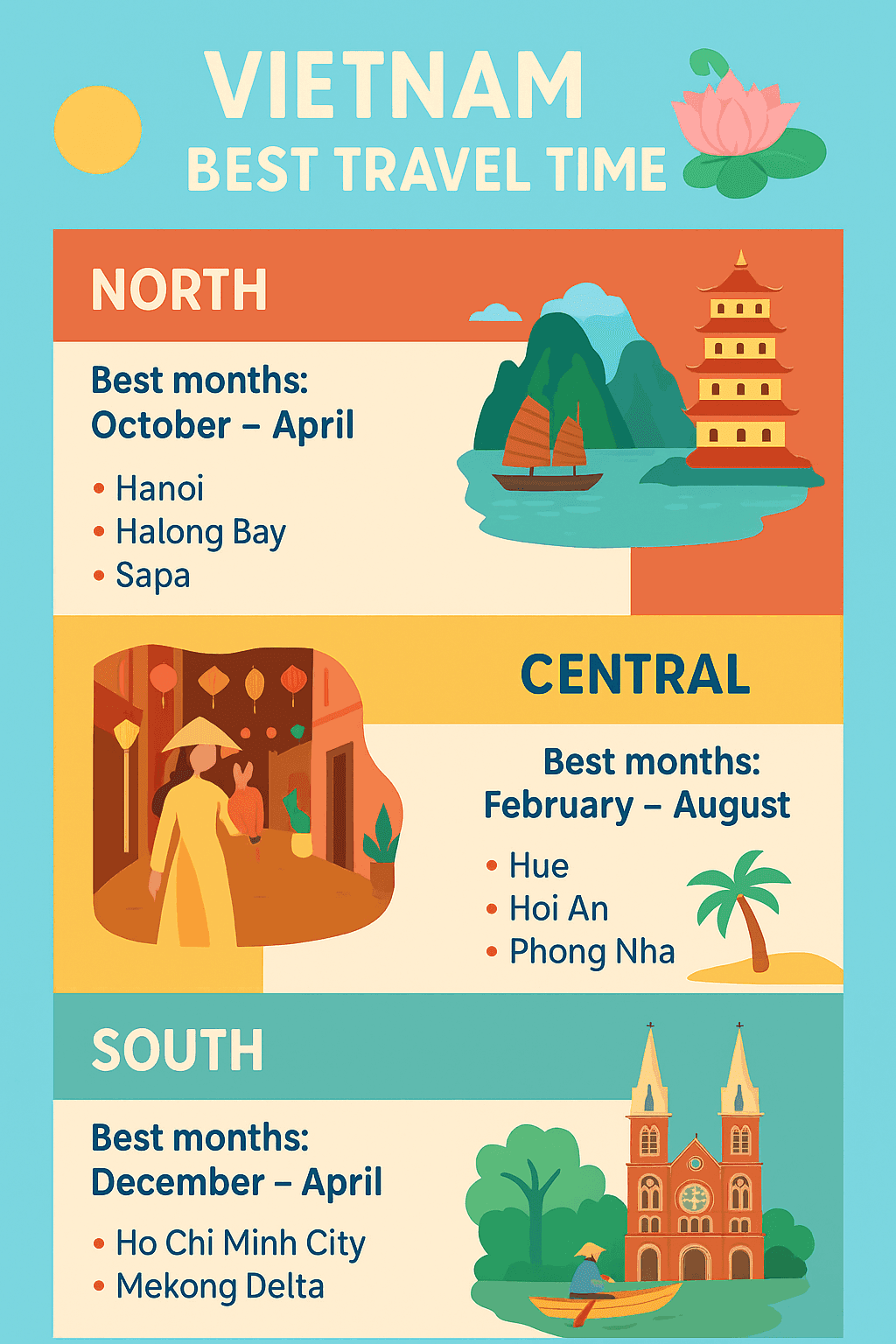
Best Time to Visit Vietnam
Blessed with a tropical yet diverse climate, Vietnam welcomes travelers all year round — from misty mountains in the north to golden beaches in the south. Each region shines in its own season, offering a unique experience every time you visit.
North Vietnam (Hanoi, Halong Bay, Sapa, Ninh Binh)
Best time: October – April Cool, dry weather and clear skies make this the perfect season to explore. Cruise through Halong Bay’s emerald waters, trek the terraced fields of Sapa, or cycle between ancient temples in Ninh Binh. Travel tip: Spring (March–April) is a photographer’s dream with blooming peach blossoms and mustard flowers.
Central Vietnam (Hue, Hoi An, Da Nang, Phong Nha)
Best time: February – August Expect plenty of sunshine and warm breezes — ideal for beaches and sightseeing. Discover Hue’s royal history, join the lantern-lit nights of Hoi An, and unwind on Da Nang’s sandy shores. Travel tip: Typhoon season usually hits around October–November, so plan accordingly.
South Vietnam (Ho Chi Minh City, Mekong Delta, Phu Quoc)
Best time: December – April Sunny skies and tropical warmth make this the most popular time to visit. Explore the vibrant streets of Saigon, drift through the Mekong Delta’s waterways, or bask on Phu Quoc’s pristine beaches. Travel tip: Early rains in May–June turn the countryside lush and green — perfect for nature lovers.
Travel tips
Health Precautions
Vietnam does not officially require any vaccinations for entry. However, it is wise to consult your physician or a travel health clinic before your trip to discuss recommended immunizations such as typhoid, tetanus, hepatitis A & B, and malaria. Comprehensive travel insurance is strongly advised, covering medical emergencies, personal belongings, and unforeseen incidents.
Electricity
The standard electrical supply is 220V / 50Hz. Two-pin ungrounded plugs are more common than three-pin types. Travelers with devices requiring special plugs should bring an adapter, ideally a universal adapter to avoid compatibility issues.
Currency & Payments
The local currency is the Vietnamese Dong (VND). US dollars can be exchanged at authorized banks, hotels, or licensed currency exchange counters. While checks are rarely accepted, Visa, MasterCard, and JCB are widely usable, and some places also accept American Express. Expect bank transaction fees (around 3% for most cards, 4% for AMEX). ATMs are widely available in major tourist destinations.
Packing Suggestions
Travel light for convenience. Consult the local weather forecast before departure and pack essentials such as sunscreen, lightweight clothing, hats, and insect repellent.
Safety Tips
Avoid displaying valuables or large sums of money in public. Keep your belongings secure at all times, especially in crowded areas, on public transport, and at markets. Petty theft can happen in busy spots—stay alert.
Cultural Etiquette
- Dress modestly in rural areas, temples, museums, and heritage sites.
- Avoid pointing directly at people or objects with your finger.
- Do not touch someone’s head—it is considered disrespectful.
- Show courtesy to the elderly by speaking softly, offering help, and giving them priority.
- Always ask before taking photos of locals.
Time Zone & Business Hours
Vietnam operates on GMT+7. Government offices typically open 8:00–8:30 AM to 4:30–5:00 PM, Monday–Friday, with a lunch break from 11:30 AM to 1:30 PM. Banks close by 4:00 PM. Many private businesses may open on Saturday mornings. Shops often operate daily until 8:00 or 9:00 PM.
Museums & Attractions
- Ho Chi Minh Mausoleum: Open mornings only, closed Mondays & Fridays, and closed for maintenance in October–November.
- Most museums close on Mondays, except the War Remnants Museum in Ho Chi Minh City (open Mondays) and the Ho Chi Minh Trails Museum (closed Mondays & Fridays).
- Fine Arts Museum: Daily, 8:30 AM–5:30 PM.
Language
Vietnamese is the official language. English is widely spoken in business and tourist areas. Other languages encountered include French, German, Spanish, Italian, Chinese, Japanese, Thai, and Russian.
Internet Access
High-speed internet and Wi-Fi are common in hotels, cafés, and many public areas. Free Wi-Fi is available at some international airports.
Postal Services
Vietnam offers both standard international post and EMS (Express Mail Service) to over 50 countries, with delivery times from 2–10 days.
Telecommunications
International calls can be costly—confirm hotel surcharges before dialing. Using VOIP services or local prepaid SIM cards is a cheaper option (around USD 5 for calls, messages, and data). GSM networks include Vinaphone, Mobifone, and Viettel. Basic mobile phones can be bought locally for around USD 15.
Domestic Flights
Flight schedules may change without notice. Check in at least one hour before departure. Economy class allows 20kg of checked baggage and 7kg of carry-on. Always reconfirm your flights at least 24 hours before departure. Airport departure taxes are already included in ticket prices.
Food & Drinks
Vietnamese cuisine is known for its fresh ingredients and light flavors, influenced by Chinese and French cooking. Popular dishes include pho (noodle soup), cha cuon (fried spring rolls), and goi cuon (fresh spring rolls). Exotic fruits like mangosteen, rambutan, and dragon fruit are available year-round. Tap water is not recommended for drinking—bottled water is inexpensive and widely available.
Shopping & Bargaining
From high-end malls to bustling street markets, shopping in Vietnam offers something for everyone. The country is well-known for handicrafts, art, antiques, and gemstones. Bargaining is expected in markets—do it with a smile. Research average prices beforehand to avoid overpaying. If you are approached by street vendors and are not interested, politely decline and walk away without hesitation.


Welcome to Laos
Capital: Vientiane
Currency: Lao kip (LAK)
Official Language: Lao
Major Cities: Vientiane, Luang Prabang, Pakse, Savannakhet
Unique Highlights:
- Peaceful, laid-back lifestyle with strong Buddhist influence
- Ancient temples, including Wat Xieng Thong and That Luang
- Stunning natural beauty
Visa to Laos
Laos Visa Guide (Updated 2024)
Visa Exemption
Citizens from 15 countries can enter Laos without a visa for tourism purposes for a limited stay.
Visa-free entry duration:
- 14 days: Myanmar
- 15 days: Japan, Luxembourg, Switzerland
- 30 days: Brunei Darussalam, Cambodia, Indonesia, Malaysia, Mongolia, Philippines, Russia, Singapore, South Korea, Thailand, Vietnam
Important notes: If you plan to stay beyond the permitted period or travel for non-tourism purposes, a visa is required. Visa policies may change, so always verify with the nearest Lao embassy or consulate before traveling.
Visa on Arrival (VOA)
The Visa on Arrival is available at major airports and international border checkpoints. Ftrip Vietnam can assist with your pre-approval process to ensure a smooth arrival.
Steps to obtain VOA:
- Arrive at one of the designated entry points.
- Fill out the visa application form and prepare two (02) passport photos.
- Pay the visa fee in cash (USD only); the fee varies dependingthe on your nationality.
- Wait for processing (usually 15–30 minutes).
Eligible entry points include:
- Wattay International Airport (Vientiane)
- Luang Prabang International Airport
- Pakse International Airport (Champasak)
- Savannakhet International Airport
Requirements:
- Passport valid for at least 6 months from the entry date
- Completed visa form
- Two passport photos
- Cash payment (credit cards not accepted)
,E-Visa for Laos
The Laos E-Visa system allows citizens of 144 countries to apply for a tourist visa online through the official website: www.laoevisa.gov.la
Requirements:
- Passport valid for 6 months or longer with 2 blank pages
- One recent 4x6 cm digital color photo
- E-visa fee (amount varies by nationality, non-refundable)
Processing time: Normally, 3 working days after completing the application and payment.
Advantages:
- Apply anywhere with internet access
- No need to queue at the airport
- Accepted at major international entry points
Eligible nationalities (partial list): Australia, Austria, Belgium, Brazil, Cambodia, Canada, China, France, Germany, India, Indonesia, Italy, Japan, Malaysia, Netherlands, New Zealand, Philippines, Russia, Singapore, South Korea, Thailand, United Kingdom, United States, Vietnam, and more.
Best time to travel
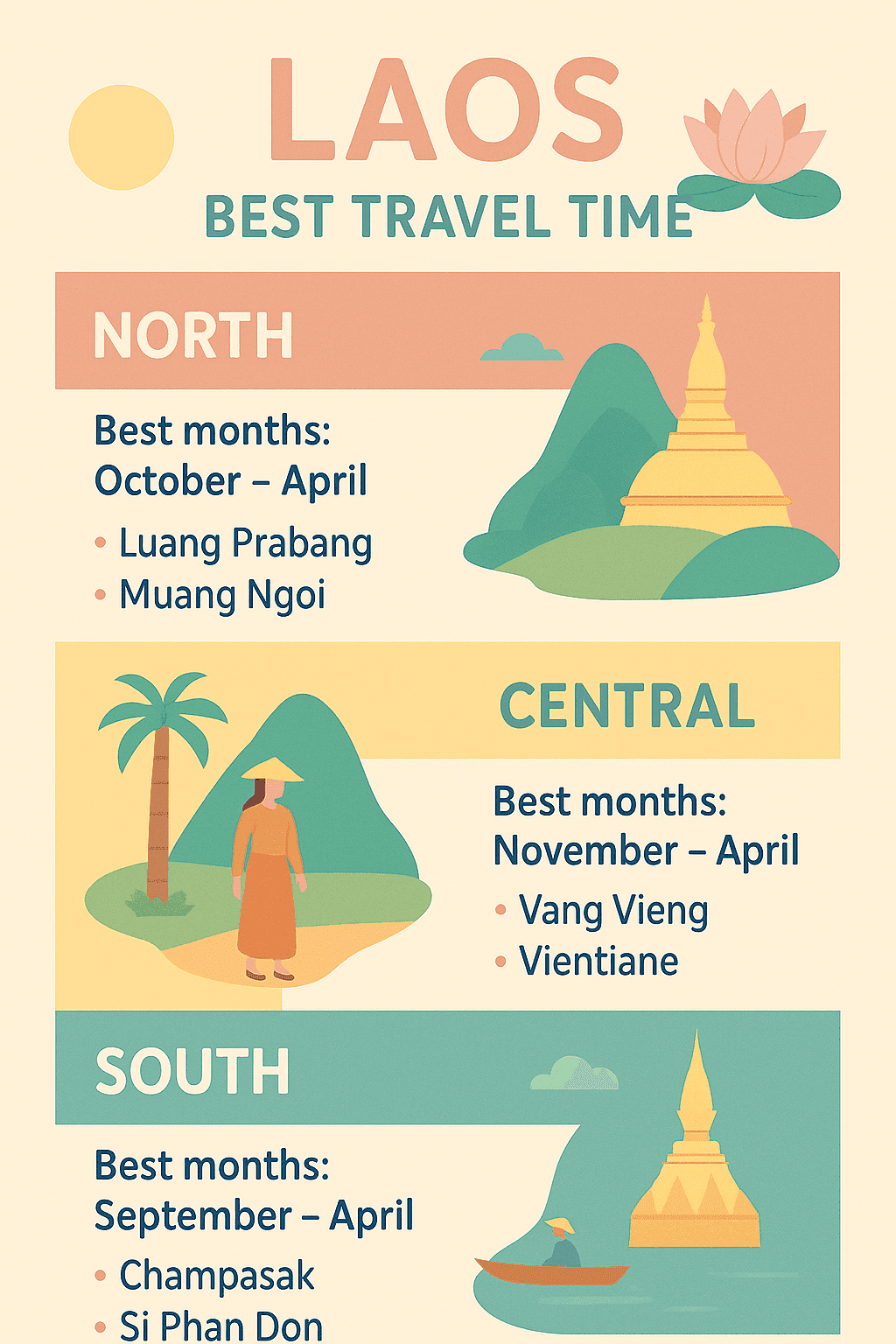
Best Time to Visit Laos
Laos is beautiful year-round, but the best time for most travelers is from November to February, when the weather is dry, warm, and ideal for exploring both the North and South.
Southern Laos (Pakse, Four Thousand Islands)
Best months: November – February
- Dry season with warm, comfortable weather
- Perfect for river cruises, island-hopping, and exploring Champasak
- March–April: Hot and humid
- May–October: Rainy season, heavy rain in September–October may cause flooding
Northern Laos (Luang Prabang, Kuang Si Waterfalls)
Best months: October – March
- Cool and dry climate, especially pleasant in October–November and February–March
- December–January: Can be chilly in the mountains
- March–May: Hot and hazy due to annual field burning, affecting visibility
Travel Combinations
If you plan to combine Laos with Vietnam and/or Cambodia, the period from October to March is ideal.
- Aligns with dry season in South Vietnam
- Matches autumn–winter in North Vietnam (peak travel season)
- Coincides with dry season in Cambodia
🌧️ Why Travel During the Early Rainy Season
- Short, refreshing showers — not constant rain
- Lower hotel and tour prices
- Rivers at excellent levels for boat cruises and waterfall views
Festival Highlight – Songkran (Lao New Year)
When: Mid-April Celebrate Lao New Year with joyful water fights, symbolizing cleansing and renewal. Expect lively streets, laughter, and a festive spirit — it’s New Year meets a giant street party!
Travel tips
Essential Travel Guide to Laos
Health & Medical Care
Healthcare in Laos is mostly provided through government hospitals, while private clinics and pharmacies can be found in major cities like Vientiane and Luang Prabang. Common medicines from France, the U.S., Thailand, China, and Russia are widely available. If you take any specific medication, it’s still best to bring your own supply.
Electricity
Laos uses 220 volts / 50 Hz electricity. Power outlets vary, so a universal plug adapter is recommended for all travelers.
Currency & Money Matters
- Currency: Lao Kip (LAK)
- Exchange: Available at banks, exchange counters, and some hotels.
- Credit Cards: Accepted at large hotels, restaurants, and certain shops in major cities.
- ATMs: Easy to find in tourist areas. 💡 Exchange rates change slightly every day, but not significantly.
What to Pack
Light, breathable cotton clothing is ideal year-round. A light jacket or sweater will be useful for cool evenings and trips to higher elevations. For temple visits, remember to cover shoulders and knees — it’s both respectful and required.
Local Etiquette
Laos is deeply rooted in Buddhist traditions, and modesty is important. Here are a few essential do’s and don’ts:
- Dress modestly, especially in temples or villages.
- Women should avoid touching monks or handing them items directly.
- Public affection (hugging, kissing) is frowned upon, particularly in rural areas.
- Avoid touching anyone’s head or pointing with your feet — these are considered disrespectful. The Lao people are gentle and polite, and they appreciate visitors who show the same kindness and respect.
Time Zone & Daily Life
Laos follows GMT +7, the same as Thailand and Vietnam. Government offices and banks are usually open Monday to Friday, from 8:00 AM to 4:00 PM.
Language
The official language is Lao, closely related to Thai — so many locals understand Thai as well. Lao is a tonal language with six tones, but even a simple “Sabaidee!” (hello) will bring big smiles and instant warmth from the locals.
Internet & Connectivity
Internet access is now fast and affordable across Laos. Most hotels, cafés, and restaurants offer free Wi-Fi, and prepaid SIM cards are inexpensive for unlocked phones. Mobile coverage is reliable in cities and most tourist destinations.
✈️ Flights & Transportation
- Vientiane (Wattay International Airport): Around 20 minutes from downtown. Taxis cost about US$4.
- Luang Prabang International Airport: Connects directly with Vietnam, Thailand, and Cambodia. Domestic flights are available between key cities, though overland travel by bus or private car is also a popular choice.
🍚 Food & Drinks
Laotian cuisine is simple but flavorful — expect sticky rice, fresh herbs, and spicy dips served family-style. Locals traditionally sit on the floor and share dishes. Popular influences come from Thailand and the former French colony, which explains why you’ll find delicious baguettes and coffee alongside papaya salad and grilled meats. Don’t miss larb (spicy minced meat salad) and tam mak hoong (papaya salad)!
📰 Media & Communications
News in English, French, and Thai is available on Lao National Radio. Local and Thai television channels are widely broadcast, and satellite TV is common in hotels.


Welcome to Cambodia
Capital: Phnom Penh
Currency: Cambodian riel (KHR); US dollars widely accepted
Official Language: Khmer
Major Cities: Phnom Penh, Siem Reap, Sihanoukville
Unique Highlights:
- Home to the iconic Angkor Wat – the largest religious monument in the world
- Rich history of the Khmer Empire and vibrant modern arts scene
- Delicious cuisine: fish amok, kuy teav, and sticky rice desserts
- Tonle Sap Lake and floating villages
Visa to Cambodia
Visa & Entry Information for Cambodia
Traveling to Cambodia is simple and convenient, with several visa options available depending on your nationality and travel plans.
Visa on Arrival
Citizens from most countries can obtain a visa on arrival at major international airports (Phnom Penh, Siem Reap, Sihanoukville) and selected land borders.
- Requirements: Passport valid for at least 6 months, one passport photo, and visa fee (USD cash only).
- Processing time: Around 15–30 minutes. Available visa types include Tourist (T) and Ordinary (E) visas, which can later be extended for longer stays.
E-Visa (Online Application)
For added convenience, travelers can apply for an E-Visa before arrival at www.evisa.gov.kh.
- Fee: USD 30 + USD 6 processing charge
- Processing time: Approximately 3 working days
- Validity: 90 days from issue, for a 30-day stay Accepted at Phnom Penh, Siem Reap, and Sihanoukville airports.
Visa from Cambodian Embassies
If preferred, travelers may apply in advance through a Cambodian embassy. Required documents vary but generally include passport photos, proof of insurance, and an invitation letter (for business or study purposes).
E-Arrival Card
Cambodia is introducing a digital immigration and customs form, available via arrival.gov.kh or the “Cambodia e-Arrival” app. Currently, the system is in trial at Siem Reap International Airport. Paper forms remain in use elsewhere.
Travel Tips
✅ Always check entry requirements before traveling, as visa rules can change. ✅ Bring USD in small denominations for visa fees. ✅ Keep printed copies of your visa approval and travel documents for smooth entry.
Best time to travel
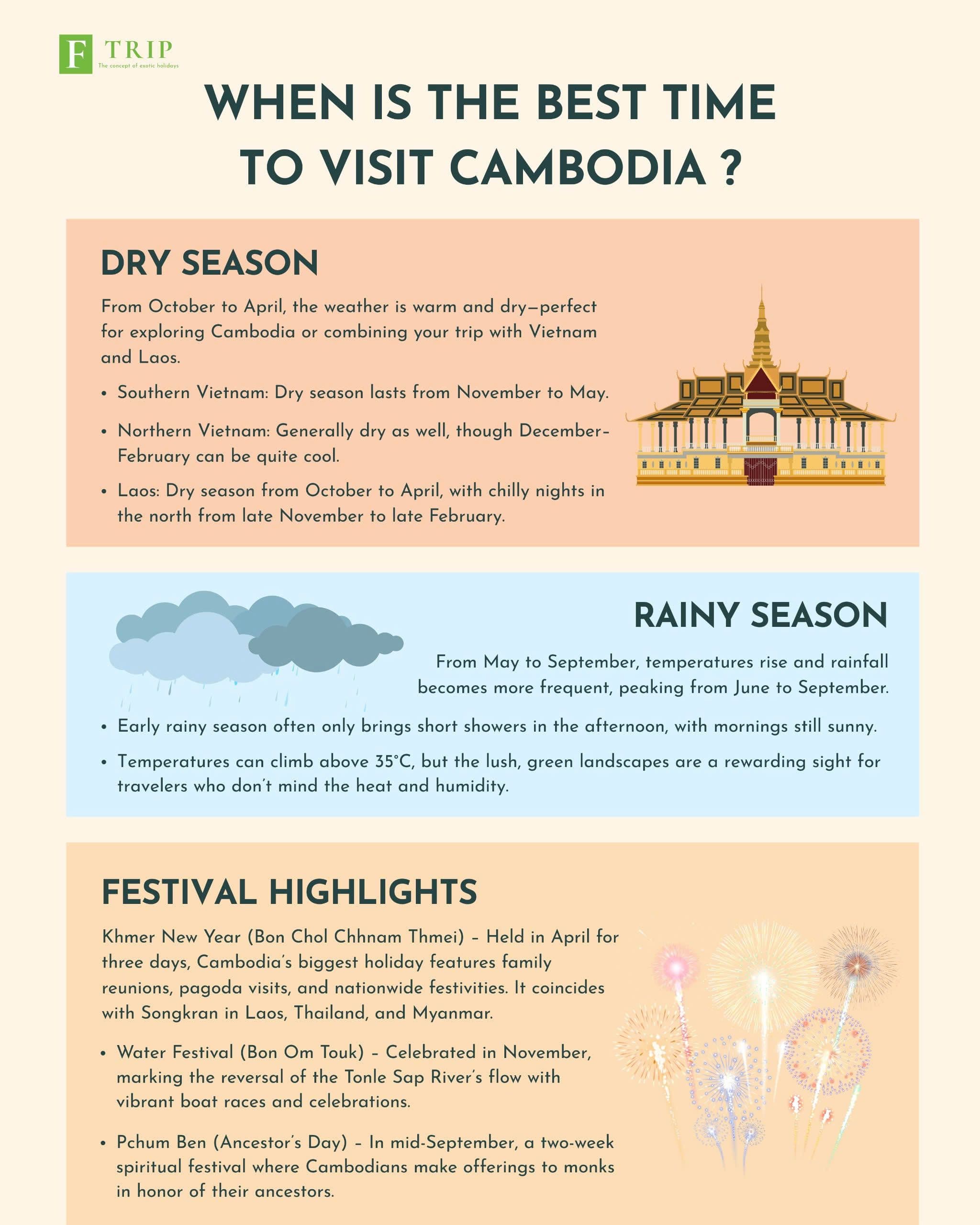
When Is the Best Time to Visit Cambodia?
Cambodia’s dry season runs from October to April, bringing warm, pleasant weather and clear skies — ideal for exploring temples, beaches, and countryside landscapes. This period also aligns perfectly with the dry seasons in Vietnam and Laos, making it the best time for an Indochina journey.
- South Vietnam: Dry from November to May.
- North Vietnam: Mostly dry except for the cooler months (December–February).
- Laos: Dry from October to April, with chilly nights in the north between late November and February.
If you’re planning a multi-country Southeast Asia trip, this shared dry season is the perfect window.
Visiting During the Rainy Season (May–September)
From May onward, temperatures rise and rain becomes more frequent, peaking between June and September. Early in the season, showers are usually short and fall in the late afternoon, leaving mornings bright and clear. While daytime highs can exceed 35°C, the lush green landscapes and refreshed atmosphere are a reward for travelers who don’t mind the humidity.
💡 Budget tip: The early and late rainy months offer lower prices on hotels and tours, and fewer crowds at major attractions — a great time for photographers and slow travelers.
Festival Highlights
For many travelers, the best time to visit Cambodia is not just about the weather, but about immersing in its cultural celebrations:
- Khmer New Year (Bon Chol Chhnam Thmei) – Cambodia’s biggest holiday, celebrated over three days in April with family reunions, temple visits, and joyous water festivities. It coincides with Songkran in Laos, Thailand, and Myanmar.
- Water Festival (Bon Om Touk) – Held in November, this spectacular event marks the reversal of the Tonle Sap River’s flow, featuring colorful boat races, music, and celebrations across the country.
- Pchum Ben (Ancestor’s Day) – A two-week spiritual observance in September, when Cambodians visit pagodas and make offerings to honor their ancestors.
Travel tips
HEALTH REQUIREMENTS
There are no officially required vaccinations. Travelers are advised to check with their doctor or a travel immunization clinic regarding the advisability of inoculations against typhoid, tetanus, hepatitis A & B, and malaria. It is recommended that all travelers purchase comprehensive Personal Travel Insurance to cover personal belongings and medical expenses in case of an accident or illness.
ELECTRICITY
The usual voltage is 220V, 50Hz. A two-pin (ungrounded) plug is more popular than the three-pin one. If you have any devices needing a special outlet, please bring their adapter kit. The best investment is a universal AC adapter, which will enable you to plug it in anywhere without damaging the appliances.
CURRENCY, EXCHANGE & ATM
The local currency is the Riel, although the US dollar is widely accepted throughout the country and in all major markets. In recent years, the rate of exchange has been floating at around USD1 = 4,000 Riels. Some most-used Riel denominations include: 500, 1000, 2000, 5000, 10000 notes.
PACKING LIST - CAMBODIA TRAVEL TIPS
Light clothing made from natural fibers is the best clothing for the region. Warm clothing is needed for December and January, and a light jacket is often necessary in the lowlands. Warmer clothing may be needed if travelling in the highlands. Most towns have markets where you can buy a warm jacket for a fraction of the price you would pay at home.
ETIQUETTE
Cambodia is a Buddhist country, and as in other Buddhist countries, it is seen as inappropriate to dress in a provocative way, such as wearing beach attire in the city. It is especially true when visiting pagodas, as women shall wear clothes that cover their skin from their shoulders to their knees. Also, women shall not touch the monks or hand any item directly at them. These are important travel tips for Cambodia that you shouldn't ignore!
TIME ZONE & WORKING HOURS
Local time is GMT + 7 hours. Most business offices are open from 8:00 a.m. to 12:00 p.m. and from 1:00 p.m. to 5:00 p.m., Mondays through Fridays. Banks generally operate from 8:00 a.m. to 3:00 p.m. Most private companies work on Saturdays, while government offices are closed.
LANGUAGE
Khmer is the official language. English and French are the second languages.
INTERNET
It is easy and cheap to access the Internet and emails in Cambodia. There are plenty of internet cafes, and many are open until late at night. Currently, the charge is between 50 cents to 1 USD per hour, and falling.
POST AND TELECOMMUNICATIONS
There are two gateways for international telephone access from Cambodia by dialing 001 or 007, followed by the country code and the phone number.
There are also four cellular phone service providers offering convenient communication via the GSM system; most of the local people now carry mobile phones. International Direct Dialing (IDD) calls and faxing are also available.
DOMESTIC FLIGHTS & AIRPORT TAXES
Flight times may vary from day to day. Schedules are subject to change without prior notice. You should allow an hour at the airport for the check-in process before flight departure. Baggage allowance is 20kg per person in economy class. Hand luggage should not weigh more than 7kg. Airport departure tax for domestic and international flights is included in the airfare issued.
FOOD AND DRINKS
Phnom Penh, Siem Reap, and Sihanouk Ville are three special places for connoisseurs of Khmer food. Rice and fish, together with an array of herbs, sauces, and spices, are the typical Khmer cuisine. Curries and soup with beef, pork, poultry, and seafood can be bought from vendors along the streets. Cuisine from all over the world is also found in Cambodia, with over 100 restaurants such as European, American, Mexican, Indian, Chinese, Japanese, Thai, Korean, Vietnamese, and many others, so visitors will have a lot of choices here.
SOUVENIR
The Krama (a traditional cotton scarf) is one of the most typical Cambodian souvenirs.
• This multi-purpose garment, similar to a sarong, is used for bathing, cleaning, protection from the sun and other purposes in the Khmer life. It is also one of the national symbols that distinguishes the Khmer people from their neighbors.
• Both cotton and silk Krama are available throughout local markets and souvenir shops. Ask the seller to demonstrate the proper way to wear the Krama so that you may carry and wear it yourself while sightseeing for a more elegant look.