- Quick Answer
- What Counts as “Traditional Vietnamese Food”
- The Ancient Foundations Behind Vietnamese Recipes
- Balance as a Cooking Philosophy
- The Role of Herbs: Vietnam’s Living Seasoning
- Fermentation and Time: The Real Secret Ingredients
- Signature Traditional Techniques (The “How”)
- Broths That Define the Soul of Vietnam
- Charcoal Grilling and Smoke
- Braising in Clay Pots (Cooking for Depth)
- Rice Mastery: Vietnam’s Quiet Superpower
- Traditional Vietnamese Food by Region (History Shapes Flavor)
- Northern Vietnam
- Central Vietnam
- Southern Vietnam
- Ancient Ritual Foods: Eating for Meaning
- Traditional Vietnamese Meals at Home
- How to Taste Traditional Vietnamese Food Correctly
- Mini Traditional Dish Spotlights
- Modern vs Traditional: What’s Changing (and What Isn’t)
- FtripVietnam Traditional Food Experiences
- FAQs
- Conclusion
Vietnamese cooking isn’t just about recipes. It is memory, medicine, and method—broths simmered for hours, sauces aged patiently, and herbs chosen with the same care as healing ingredients.
Behind every bowl of soup or plate of rice is a system shaped by climate, history, philosophy, and time. This guide uncovers the ancient roots and hidden techniques behind traditional Vietnamese food—so you understand why it tastes the way it does, not just what to order.
Quick Answer
Traditional Vietnamese cuisine is built on balance (yin–yang food principles), fresh herbs, fermentation (fish sauce, shrimp paste, pickles), and slow techniques such as long-simmered broths, braising, and charcoal grilling. Its “secrets” come from regional history: Chinese influence in the North, imperial refinement and spice in Central Vietnam, and tropical abundance in the South. To experience true tradition, focus on specialist dishes like phở, bún bò Huế, cơm tấm, and bánh xèo—prepared by cooks who still rely on time-honored methods rather than shortcuts.
What Counts as “Traditional Vietnamese Food”
Traditional Vietnamese food is not one fixed menu. It changes by context.
- Everyday home cooking: simple, seasonal, ingredient-driven
- Festival foods: symbolic dishes tied to rituals and ancestors
- Royal/imperial cuisine: refined techniques, small plates, visual harmony
Many traditional dishes began as village recipes, shaped by what grew locally, what could be preserved, and what suited the climate. Tradition also evolves across generations—methods stay, details adapt.
The Ancient Foundations Behind Vietnamese Recipes
Balance as a Cooking Philosophy
Vietnamese cuisine follows a food-based yin–yang logic.
- Cooling vs warming foods: herbs, vegetables, seafood balance meats and spices
- Five-flavor harmony: salty, sweet, sour, spicy, bitter/umami
- Texture balance: crispy with soft, fresh with cooked, hot with cool
A meal is considered “right” only when these elements coexist.
The Role of Herbs: Vietnam’s Living Seasoning
Herbs are not garnish - they are structured.
- Core families: mint, perilla, Vietnamese coriander, dill, basil
- Served separately so diners build flavor themselves
- Regional herb baskets differ dramatically
Herbs cool the body, refresh the palate, and complete the dish nutritionally and aromatically.
Fermentation and Time: The Real Secret Ingredients
Vietnamese depth comes from patience.
- Fish sauce (nước mắm): aged months to years for umami and balance
- Shrimp paste (mắm tôm) & fermented sauces: sharp, complex, regional
- Pickles (đồ chua): acidity that wakes up rich foods
Fermentation preserves, intensifies, and balances - long before refrigeration existed.
Signature Traditional Techniques (The “How”)
Broths That Define the Soul of Vietnam
- Long simmering of bones with aromatics
- Careful skimming for clarity
- Seasoned gradually, never rushed
Northern broths aim for clarity, Central broths for depth and spice, Southern broths for roundness and sweetness.
Charcoal Grilling and Smoke
Charcoal matters.
- Bún chả and street meats rely on smoke for aroma
- Marinades use fish sauce, garlic, lemongrass, caramelization
- Gas heat changes the flavor completely
Braising in Clay Pots (Cooking for Depth)
Classic dishes like cá kho tộ and thịt kho depend on:
- Slow reduction
- Caramel sauce (nước màu) for color and bitterness
- Clay pots that retain steady heat
This is food designed to improve over time.
Rice Mastery: Vietnam’s Quiet Superpower
Vietnamese cuisine transforms rice into many forms:
- Broken rice (cơm tấm)
- Sticky rice (xôi)
- Rice paper, noodles, vermicelli
Texture matters as much as taste, and each dish requires a specific rice form.
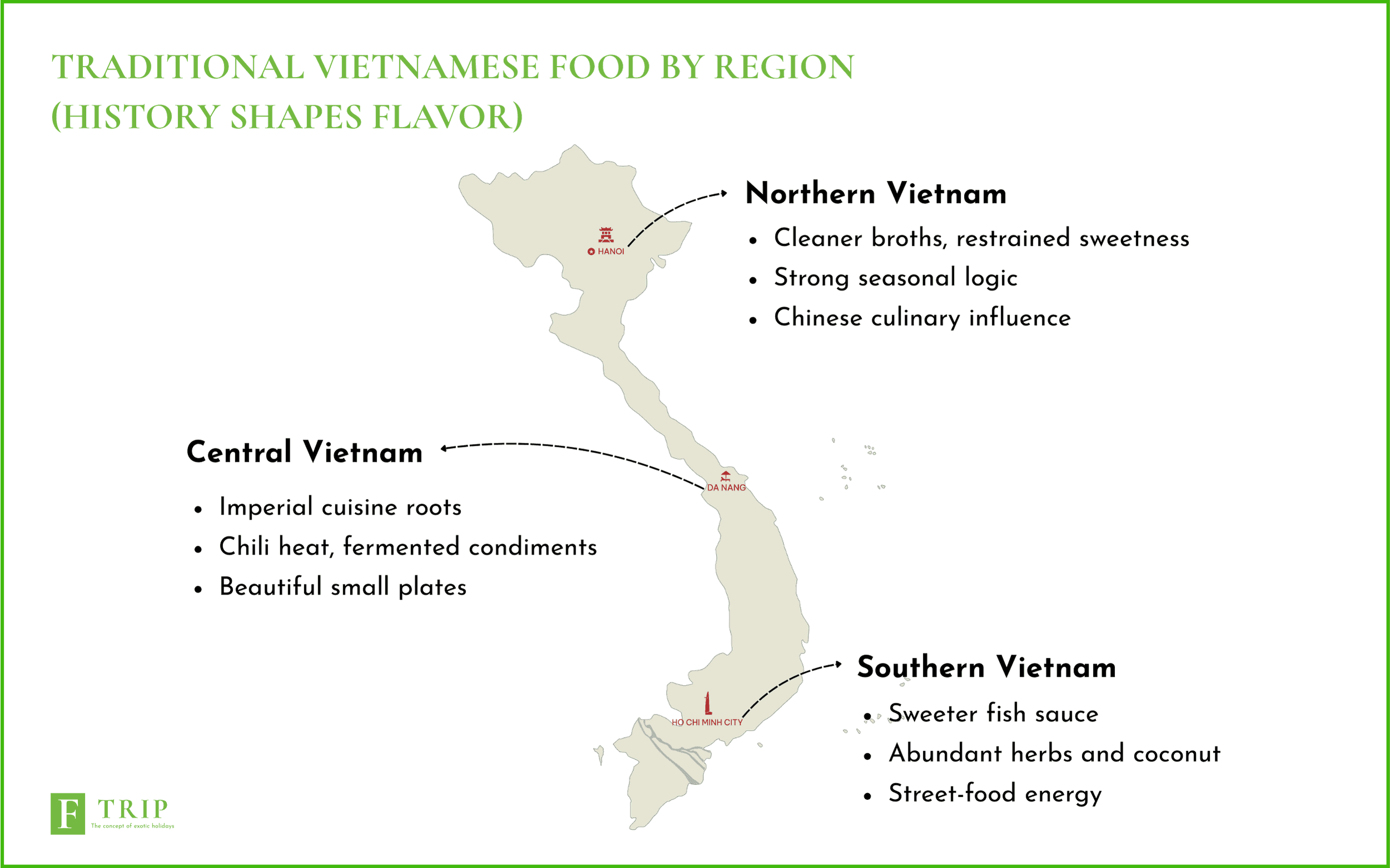
Traditional Vietnamese Food by Region (History Shapes Flavor)
Northern Vietnam
Centered around Hanoi
- Cleaner broths, restrained sweetness
- Strong seasonal logic
- Chinese culinary influence
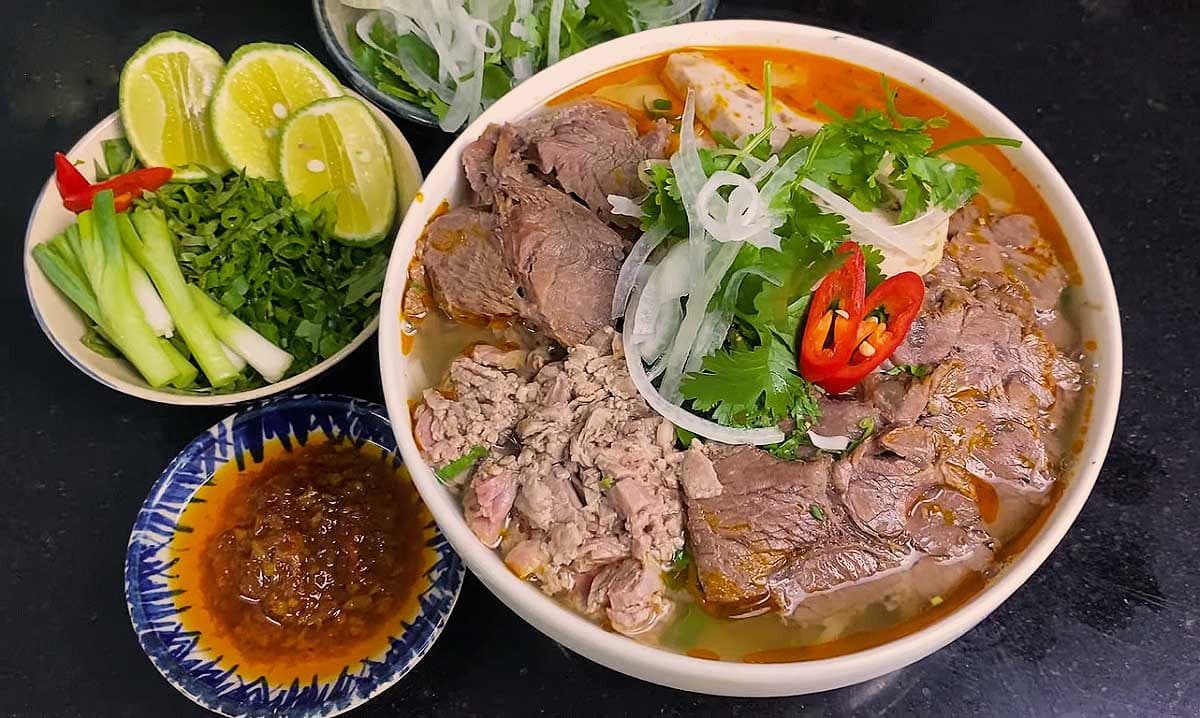
Icon dishes: phở, bún thang, chả cá, bánh cuốn
Central Vietnam
Centered around Hue
- Imperial cuisine roots
- Chili heat, fermented condiments
- Beautiful small plates
Icon dishes: bún bò Huế, mì Quảng, bánh bèo/nậm/lọc, cao lầu
Southern Vietnam
Centered around Ho Chi Minh City and the Mekong Delta
- Sweeter fish sauce
- Abundant herbs and coconut
- Street-food energy
Icon dishes: cơm tấm, hủ tiếu, bánh mì Sài Gòn, canh chua
Ancient Ritual Foods: Eating for Meaning
- Tết: bánh chưng/bánh tét, thịt kho trứng, pickles
- Mid-Autumn: mooncakes and shared sweets
- Ancestor worship: symbolic dishes expressing continuity and respect
Food is memory made edible.
Traditional Vietnamese Meals at Home
A typical family meal includes:
- Rice
- Soup
- Stir-fry
- Braise
- Dipping sauce
- Fresh herbs
Dishes are shared. Sauces are essential, not optional. Balance is collective.
How to Taste Traditional Vietnamese Food Correctly
- Order the specialty dish first, without customization
- Eat dishes at their proper time of day
- Learn condiments: chili, lime, garlic vinegar, herbs
- Avoid places with massive, unfocused menus
Respect the system before adjusting it.
Mini Traditional Dish Spotlights
- Phở: clarity through restraint
- Bún chả: charcoal smoke and balance
- Bún bò Huế: spice + fermentation
- Cá kho tộ: caramelized depth
- Bánh xèo: crisp edge + herb wrap
- Fish sauce: time equals flavor
Modern vs Traditional: What’s Changing (and What Isn’t)
Restaurants may modernize presentation, but:
- Markets still teach tradition
- Families preserve techniques
- Time, balance, and fermentation remain non-negotiable
Traditional cooking survives because it works.
FtripVietnam Traditional Food Experiences
- Regional food journeys: Northern classics, Central imperial flavors, Southern home-style dishes
- Market-to-table tours with ingredient storytelling
- Cooking classes focused on broth, grilling, and clay-pot braising
- Timed food itineraries from breakfast to dinner
- Diet-friendly customization without losing authenticity
FAQs
What is considered traditional Vietnamese food? Dishes rooted in regional history, balance, and time-based techniques.
What is the secret behind Vietnamese flavor balance? Yin–yang logic, herbs, fermentation, and restraint.
Why are herbs so important? They complete flavor, texture, and digestion.
How do regions differ? North is subtle, Central is bold, South is sweet and abundant.
How can tourists find traditional dishes? Follow specialists, timing, and local rhythms.
Conclusion
The ancient “secrets” of Vietnamese food are not hidden ingredients. They are time, balance, fermentation, and regional identity.
Use this guide to eat with understanding—or let FtripVietnam design a traditional-food journey that connects markets, kitchens, and heritage dining into one meaningful experience.


Founder & Photography Guide
Specialties: Culture, landscape, portrait, hiking, active and adventurous tour
Besides my unlimited passion for traveling, a professional tour guide for over a decade, I have been taking photographs since sitting at Hanoi of the University of Culture in the early 2000s. Photography started as a hobby but it was seriously taken due to my work relations and my significant passion for the beauty of our world, especially in Southeast Asian parts such as Vietnam, Laos, Cambodia, and Myanmar.
Within a few years of taking photographs, my works began to be recognized by many reliable international publications such as AFAR Travel, The Times, and The Daily Telegraph newspaper. In addition, I continuously add to my growing profile by winning numerous major awards: 3rd Position of The Independent Photographer 2018, 1st Position of Amateur Photographer of the year 2018, Grand Prize Winner of the AFAR Travel Photography 2019, and a Gold Award of San Francisco Bay International Photography 2020.
I photograph a wide variety of subjects, from travel to landscapes to street scenes. I enjoy documenting the East’s rich cultural heritage and its land soaked in glorious sunrise or sunset light in remote and secluded spots. And, I am very happy to share my knowledge and experience with you. You can visit Luminousvietnamtour to explore tour!